1. Introduction
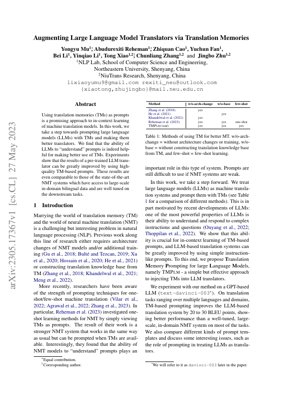
This research paper, "Augmenting Large Language Model Translators via Translation Memories," investigates a novel approach to improve machine translation (MT) by leveraging the in-context learning capabilities of Large Language Models (LLMs). The core idea is to use Translation Memories (TMs)—databases of past human translations—as dynamic prompts to guide LLMs, eliminating the need for architectural changes or extensive retraining of the base model. This method, termed Translation Memory Prompting for Large Language Models (TMP-LM), demonstrates significant performance gains, making LLM-based translation competitive with state-of-the-art Neural Machine Translation (NMT) systems fine-tuned on large in-domain datasets.
2. Methodology
2.1. Translation Memory Prompting (TMP-LM)
TMP-LM is a simple yet effective few-shot prompting strategy. For a given source sentence $x$ to translate, the system retrieves $k$ relevant translation pairs $(x^{tm}_i, y^{tm}_i)$ from a TM. These pairs are formatted into a prompt following a specific template, which is then prepended to the instruction for translating $x$. The LLM, conditioned on this prompt, generates the translation $y$. The process can be formalized as finding $y$ that maximizes $P(y | f_{ref}(x^{tm}_1, y^{tm}_1, ..., x^{tm}_k, y^{tm}_k, x), \theta)$, where $f_{ref}$ is the prompt template function and $\theta$ are the LLM parameters.
2.2. Prompt Template Design
The paper explores different prompt styles, primarily contrasting INSTRUCTION and CODE formats (see Figure 1 in the PDF). The INSTRUCTION format uses natural language (e.g., "If the translation of X1 is Y1..., then what is the translation of X?"). The CODE format uses a structured, key-value style (e.g., "[src-lang]=[X1] [tgt-lang]=[Y1]..."). The choice of template significantly impacts the LLM's ability to utilize the provided TM examples effectively.
Key Improvement
20-30 BLEU
Points gained over base LLM translator
Core Advantage
Zero Architecture Change
Uses standard LLM via prompting only
Comparison Baseline
SOTA NMT
Competes with heavily fine-tuned models
3. Experiments & Results
3.1. Experimental Setup
Experiments were conducted using the GPT-3.5 model (text-davinci-003, referred to as davinci-003) across multiple language pairs (e.g., Zh-En, De-En) and domains (IT, Koran, Medical, Law). Translation Memories were constructed from in-domain data. Performance was evaluated using the BLEU score, comparing TMP-LM against a strong baseline: the base davinci-003 model without TM prompts and against a well-tuned, large-scale NMT system (the SOTA baseline).
3.2. Main Results
The results are striking. TMP-LM improved the translation quality of the base LLM by 20 to 30 BLEU points across various tasks. On most test sets, the prompted LLM's performance was comparable to or even surpassed that of the dedicated, in-domain NMT system. This demonstrates the immense potential of in-context learning with high-quality prompts for adapting general-purpose LLMs to specialized translation tasks.
3.3. Ablation Studies
Ablation studies confirmed the importance of both TM quality and prompt design. The performance gain was directly correlated with the relevance and accuracy of the TM examples retrieved. Furthermore, the CODE-style prompt generally yielded more robust and consistent improvements than the INSTRUCTION-style prompt, likely due to its clearer, less ambiguous structure for the LLM to parse.
Key Insights
- LLMs are Exceptional Prompt Learners: Their ability to "understand" and follow complex instructions is the key enabler for TMP-LM's success.
- Prompt Design is Critical: The format and clarity of the prompt template are non-trivial hyperparameters that significantly affect performance.
- TM as a Dynamic Knowledge Source: This approach turns static TM databases into active, contextual guides for LLMs, bridging classic and modern MT paradigms.
- Cost-Effective Adaptation: TMP-LM provides a path to high-quality, domain-specific translation without the computational cost of fine-tuning massive LLMs.
4. Analysis & Discussion
4.1. Core Insight
This paper isn't just about better translation; it's a masterclass in resource arbitrage. The authors have identified a critical inefficiency: the underutilization of existing, high-value translation memories (TMs) in the era of LLMs. While the industry obsesses over scaling model parameters, they demonstrate that scaling contextual intelligence—feeding LLMs the right prior examples—can yield disproportionate returns. The 20-30 BLEU point leap isn't merely an improvement; it's a paradigm shift, proving that for many tasks, a cleverly prompted generalist can outmaneuver a finely-tuned specialist. This echoes findings in other domains where in-context learning outperforms fine-tuning on data-scarce tasks, as discussed in research from institutions like Stanford's Center for Research on Foundation Models.
4.2. Logical Flow
The argument is elegantly simple and brutally effective: 1) Problem: LLMs are strong translators but lack domain specificity; TMs are rich in domain knowledge but are passive databases. 2) Hypothesis: LLMs' in-context learning can activate TMs. 3) Mechanism: Frame TM segments as few-shot prompts. 4) Validation: Massive BLEU gains across domains. 5) Implication: The optimal translation system may be a hybrid retrieval-augmented LLM, not a pure end-to-end NMT model. This flow mirrors the successful "retrieval-augmented generation" pattern seen in models like RETRO, but applies it to a mature, commercially critical problem: translation.
4.3. Strengths & Flaws
Strengths: The approach is pragmatically brilliant. It's non-invasive (no model changes), immediately deployable on APIs like OpenAI's, and leverages sunk costs (corporate TMs). It turns a liability (static TM databases) into a strategic asset. The comparison to SOTA NMT is a bold and convincing benchmark.
Flaws: The paper glosses over the elephant in the room: latency and cost. Constructing and processing long, example-heavy prompts for every sentence increases inference time and token consumption dramatically, which is prohibitive for real-time, high-volume applications. Furthermore, the method is acutely sensitive to TM quality; noisy or irrelevant TM matches could degrade performance, creating a "garbage-in, garbage-out" scenario. The reliance on a proprietary model (davinci-003) also limits reproducibility and independent verification.
4.4. Actionable Insights
For enterprise leaders: Stop treating your TM as a legacy archive. This research mandates a re-evaluation of TM assets as a core component of your AI translation stack. The first-mover advantage lies in building robust, vector-search-enabled TM retrieval systems optimized for LLM prompting.
For researchers: The CODE-style prompt is a significant finding. Future work must systematize prompt engineering for translation, moving from art to science. Exploring this with open-source LLMs (e.g., LLaMA, BLOOM) is a critical next step to democratize the approach.
For developers: Implement a fallback mechanism. Use confidence scores from the TM retrieval system; if no high-quality match is found, default to the base LLM translation to avoid degradation. This hybrid robustness is key for production systems.
5. Technical Details
The core technical innovation is the prompt formulation. Given a source sentence $x$, and $k$ retrieved TM pairs $(x_i^{tm}, y_i^{tm})$, the prompt $P$ is constructed as:
$P = f_{ref}(x_1^{tm}, y_1^{tm}, ..., x_k^{tm}, y_k^{tm}, x)$
Where $f_{ref}$ is a template function. The LLM then computes:
$y^* = \arg\max_y P(y | P, \theta)$
The paper's experiments typically use $k=2$ or $k=4$. The retrieval of TM examples is based on similarity metrics like BM25 or embedding cosine similarity between $x$ and $x_i^{tm}$.
6. Analysis Framework Example
Scenario: A legal firm needs to translate a new contract clause from German to English. Their TM contains thousands of previously translated clauses.
Framework Application:
- Retrieval: The system uses semantic search to find the 2 most similar German source clauses from the TM and their expert English translations.
- Prompt Construction (CODE-style):
[src-lang]=[Found German Clause 1] [tgt-lang]=[English Translation 1] [src-lang]=[Found German Clause 2] [tgt-lang]=[English Translation 2] [src-lang]=[New German Clause] [tgt-lang]= - Execution: This prompt is sent to an LLM (e.g., GPT-4). The LLM, conditioned on the precise legal phrasing of the prior examples, generates a translation for the new clause that maintains consistent terminology and style.
- Output: A high-quality, domain-appropriate translation that a generic translator would likely miss.
7. Future Applications & Directions
The implications of TMP-LM extend far beyond translation:
- Controlled Text Generation: Adapting LLMs for specific brand voices, technical documentation styles, or regulatory compliance by using exemplary texts as prompts.
- Personalized AI Assistants: Using a user's past emails, reports, or messages as a "style memory" to prompt an LLM to generate new content in their unique voice.
- Code Generation & Adaptation: Prompting LLMs with a codebase's existing functions and patterns to generate new code that follows the same conventions and architecture.
- Future Research: Key directions include optimizing prompt compression to reduce costs, developing better retrieval models for fuzzy TM matching, and exploring the limits of in-context learning versus fine-tuning as LLMs grow larger. Integrating this with parameter-efficient fine-tuning (PEFT) methods like LoRA could yield even stronger hybrids.
8. References
- Mu, Y., Reheman, A., Cao, Z., et al. (2023). Augmenting Large Language Model Translators via Translation Memories. arXiv preprint arXiv:2305.17367.
- Brown, T., Mann, B., Ryder, N., et al. (2020). Language Models are Few-Shot Learners. Advances in Neural Information Processing Systems, 33.
- Khandelwal, U., Levy, O., Jurafsky, D., et al. (2021). Generalization through Memorization: Nearest Neighbor Language Models. International Conference on Learning Representations (ICLR).
- Borgeaud, S., Mensch, A., Hoffmann, J., et al. (2022). Improving Language Models by Retrieving from Trillions of Tokens. International Conference on Machine Learning (ICML).
- Stanford Center for Research on Foundation Models (CRFM). (2023). On the Opportunities and Risks of Foundation Models. https://crfm.stanford.edu/.
- Vaswani, A., Shazeer, N., Parmar, N., et al. (2017). Attention Is All You Need. Advances in Neural Information Processing Systems, 30.