1. Introduction
Machine Translation (MT) represents the automated process of converting text from one natural language to another. For India, a nation with 22 officially recognized languages and immense linguistic diversity, the development of robust MT systems is not merely an academic pursuit but a socio-technical imperative. The digitization of content in regional languages has created an urgent need for automated translation to bridge communication gaps in domains such as governance, education, healthcare, and commerce. This paper surveys the landscape of MT systems specifically engineered for Indian languages, tracing their evolution, methodological underpinnings, and key contributions from Indian research institutions.
2. Approaches in Machine Translation
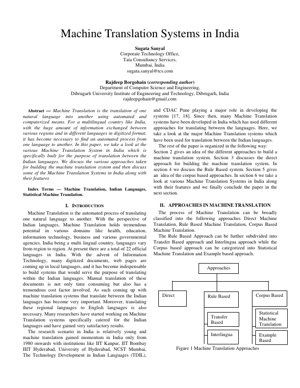
MT methodologies can be broadly classified into three paradigms, each with distinct mechanisms and philosophical foundations.
2.1 Direct Machine Translation
This is the most rudimentary approach, involving primarily word-for-word substitution using a bilingual dictionary, followed by basic syntactic reordering. It is designed for specific language pairs and operates in a unidirectional manner. The process can be conceptualized as:
Input (Source Language) → Dictionary Lookup → Word Reordering → Output (Target Language)
While simple, its accuracy is limited by the lack of deep linguistic analysis.
2.2 Rule-Based Machine Translation (RBMT)
RBMT relies on extensive linguistic rules for syntax, morphology, and semantics. It is subdivided into:
- Transfer-Based Approach: Analyzes the source language sentence into an abstract representation, applies transfer rules to convert this representation to the target language structure, and then generates the target sentence.
- Interlingua Approach: Aims to translate the source text into a language-independent intermediary representation (Interlingua), from which the target text is generated. This is more elegant but requires a complete semantic representation, making it complex to implement.
2.3 Corpus-Based Machine Translation
This data-driven approach leverages large collections of bilingual text (parallel corpora). The two main types are:
- Statistical Machine Translation (SMT): Formulates translation as a statistical inference problem. Given a source sentence s, it seeks the target sentence t that maximizes $P(t|s)$. Using Bayes' theorem, this is decomposed into a translation model $P(s|t)$ and a language model $P(t)$: $\hat{t} = \arg\max_{t} P(t|s) = \arg\max_{t} P(s|t) P(t)$.
- Example-Based Machine Translation (EBMT): Translates by analogical reasoning, matching parts of the input sentence with examples in a bilingual corpus and recombining the corresponding translations.
3. Key Machine Translation Systems in India
Indian research, spearheaded by institutions like IITs, IIITs, CDAC, and TDIL, has produced several notable MT systems.
3.1 Anusaaraka
Developed initially at IIT Kanpur and continued at IIIT Hyderabad, Anusaaraka is a prominent Direct MT system designed for translation among Indian languages and from Indian languages to English. Its key feature is the use of a "language-independent" layer of representation to facilitate multi-way translation, reducing the need for pairwise system development.
3.2 Other Notable Systems
The paper references various other systems (implied by [17,18]), which likely include:
- MANTRA: Developed by CDAC for translation of government documents.
- AnglaHindi: An early English-to-Hindi translation system.
- Shakti: A consortium project focusing on SMT for Indian languages.
Research Landscape Snapshot
Key Institutions: IIT Kanpur, IIT Bombay, IIIT Hyderabad, CDAC Pune, TDIL.
Major Thrust: Translation between Indian languages (Indic-Indic) and from English to Indian languages.
Evolution: Gained significant momentum post-1980s, moving from Direct/RBMT to Corpus-Based methods.
4. Technical Details & Mathematical Foundations
The core of modern SMT, which has become dominant, lies in its probabilistic models. The fundamental equation, as stated, is derived from the noisy channel model:
$$\hat{t} = \arg\max_{t} P(t|s) = \arg\max_{t} P(s|t) P(t)$$
Where:
- $P(s|t)$ is the translation model, typically learned from aligned parallel corpora using models like IBM Models 1-5 or Phrase-Based Models. It estimates how likely source sentence s is as a translation of target sentence t.
- $P(t)$ is the language model, often an n-gram model (e.g., trigram) trained on large monolingual corpora of the target language. It ensures the fluency of the output.
Decoding—finding the target sentence t that maximizes this product—is a complex search problem typically solved using heuristic algorithms like beam search.
5. Experimental Results & Performance
While the provided PDF excerpt does not list specific quantitative results, the trajectory of MT research indicates a clear evolution in performance metrics. Early Direct and RBMT systems for Indian languages often struggled with:
- Fluency: Outputs were frequently grammatically awkward due to limited reordering rules or dictionary coverage.
- Adequacy: Meaning preservation was inconsistent, especially for long-range dependencies and idiomatic expressions.
The adoption of SMT marked a turning point. Systems evaluated on standard metrics like BLEU (Bilingual Evaluation Understudy) showed significant improvements as the size and quality of parallel corpora (e.g., the Indian Language Corpora Initiative (ILCI) data) increased. For instance, phrase-based SMT systems for language pairs like Hindi-Bengali or English-Tamil demonstrated BLEU score improvements of 10-15 points over previous RBMT baselines when sufficient training data was available, highlighting the data-dependency of this approach.
Performance Evolution Trend
Early Systems (Pre-2000): Relied on Direct/RBMT. Performance was functional for limited domains but brittle and non-fluent.
SMT Era (2000-2015): Performance became directly correlated with available parallel data size. High-resource pairs (e.g., Hindi-English) saw good progress; low-resource pairs lagged.
Neural MT Era (Post-2015): The current state-of-the-art, using sequence-to-sequence models with attention (e.g., Transformers), has led to another leap in fluency and adequacy for supported languages, though deployment for all Indian languages remains a challenge due to data scarcity.
6. Analysis Framework: A Case Study
Scenario: Evaluating the suitability of an MT approach for translating government health advisories from English to Tamil.
Framework Application:
- Requirement Analysis: Domain-specific (health), requires high accuracy and clarity. Moderate volume of existing parallel texts (legacy documents).
- Approach Selection:
- Direct/RBMT: Rejected. Cannot handle complex medical terminology and sentence structures robustly.
- Phrase-Based SMT: Strong candidate if a domain-tuned parallel corpus of health documents is created. Allows for consistent translation of common phrases.
- Neural MT (e.g., Transformer): Optimal if sufficient training data (>100k sentence pairs) is available. Would provide the most fluent and context-aware translations.
- Implementation Strategy: For a low-data scenario, a hybrid approach is recommended: Use a base Neural MT model pre-trained on general domain data, and fine-tune it on a carefully curated, smaller set of health advisory parallel texts. Augment with a glossary of critical medical terms to ensure terminology consistency—a technique often used in commercial systems like Google's NMT.
7. Future Applications & Research Directions
The future of MT for Indian languages lies in overcoming current limitations and expanding into new applications:
- Neural Machine Translation Dominance: The shift from SMT to NMT is inevitable. Research must focus on efficient NMT models for low-resource settings, using techniques like transfer learning, multilingual models, and unsupervised/semi-supervised learning as seen in models like mBART or IndicTrans.
- Domain-Specific Adaptation: Building MT systems tailored for legal, medical, agricultural, and educational domains is crucial for real-world impact.
- Spoken Language Translation: Integration of ASR (Automatic Speech Recognition) and MT for real-time translation of speech, vital for accessibility and cross-lingual communication.
- Handling Code-Mixing: A pervasive feature of Indian digital communication (e.g., Hinglish). Developing models that understand and translate code-mixed text is an open challenge.
- Ethical AI & Bias Mitigation: Ensuring translations are not biased (e.g., gender bias) and are culturally appropriate.
8. References
- S. Sanyal and R. Borgohain. "Machine Translation Systems in India." (Source PDF).
- Koehn, P. (2009). Statistical Machine Translation. Cambridge University Press.
- Vaswani, A., et al. (2017). "Attention Is All You Need." Advances in Neural Information Processing Systems 30 (NIPS 2017).
- Technology Development for Indian Languages (TDIL) Programme. Ministry of Electronics & IT, Govt. of India. https://www.tdil-dc.in/
- Ramesh, G., et al. (2022). "IndicTrans: Towards Massively Multilingual Machine Translation for Indic Languages." Findings of the Association for Computational Linguistics: AACL-IJCNLP 2022.
- Brown, P. F., et al. (1993). "The Mathematics of Statistical Machine Translation: Parameter Estimation." Computational Linguistics, 19(2), 263-311.
- Jurafsky, D., & Martin, J. H. (2023). Speech and Language Processing (3rd ed. draft). Chapter 11: Machine Translation.
9. Original Analysis: Core Insight & Strategic Evaluation
Core Insight: The Indian MT journey is a classic case of technological adaptation battling against the "tyranny of low resources." While the global MT narrative has raced from SMT to Transformer-based NMT, India's path is defined by a pragmatic, often hybrid, approach forced by the fragmented linguistic landscape. The real story isn't about chasing the global SOTA (State-of-the-Art) on a single pair like English-French; it's about building a scaffolding that can elevate 22+ languages simultaneously with constrained data. Systems like Anusaaraka weren't just translation tools; they were early architectural bets on interoperability and resource sharing—a philosophy that is now resurgent in modern multilingual NMT models like Facebook's M2M-100 or Google's PaLM.
Logical Flow: The paper correctly maps the historical trajectory: Direct (quick, dirty, functional prototypes) → Rule-Based (linguistically rigorous but unscalable and maintenance-heavy) → Corpus-Based/SMT (data-hungry, performance plateauing). However, it implicitly stops at the cusp of the current revolution. The logical next step, which the Indian research ecosystem is actively pursuing (e.g., the IndicTrans project), is Neural & Multilingual. The key insight from global research, particularly from works like the Transformer paper, is that a single, massively multilingual model can perform surprisingly well on low-resource languages through transfer learning—a perfect fit for India's problem.
Strengths & Flaws: The strength of the early Indian MT work lies in its problem-first orientation. Building for governance (MANTRA) or accessibility (Anusaaraka) provided clear validation. The major flaw, in hindsight, was the prolonged reliance on and siloed development of RBMT systems. While institutions like IIIT-Hyderabad advanced computational linguistics, the field globally was demonstrating the superior scalability of data-driven methods. India's late but decisive pivot to SMT and now NMT is correcting this. A current strategic flaw is the under-investment in creating large, high-quality, clean, and diverse parallel corpora—the essential fuel for modern AI. Initiatives like TDIL are crucial, but scale and accessibility remain issues compared to resources for European languages.
Actionable Insights: For stakeholders (government, industry, academia):
- Bet on Multilingual NMT Foundations: Instead of building 22x22 pairwise systems, invest in a single, large foundational model for all Indian languages (and English). This aligns with global trends (e.g., BLOOM, NLLB) and maximizes resource efficiency.
- Treat Data as Critical Infrastructure: Launch a national, open-access "Indic Parallel Corpus" project with strict quality controls, covering diverse domains. Leverage government document translation as a source.
- Focus on "Last-Mile" Domain Adaptation: The foundational model provides general capability. Commercial and research value will be created by fine-tuning it for specific verticals: healthcare, law, finance, agriculture. This is where startups and specialized AI firms should compete.
- Embrace the Hybrid Paradigm for Now: In production systems for critical applications, pure neural models may still be unreliable. A hybrid approach—using NMT for fluency, backed by RBMT-style rule engines for guaranteed translation of key terms and safety checks—is a prudent strategy.
- Prioritize Evaluation Beyond BLEU: For Indian languages, translation quality must be measured by comprehension and utility, not just n-gram overlap. Develop human evaluation frameworks that test for factual accuracy in news translation or clarity in instruction manuals.
In conclusion, India's MT research has moved from a phase of isolated linguistic engineering to the threshold of integrated AI-driven language technology. The challenge is no longer just algorithmic but infrastructural and strategic. The nation that successfully builds the data pipelines and unified models for its linguistic diversity will not only solve a domestic problem but will also create a blueprint for the majority of the world that is multilingual.