1. Introduction
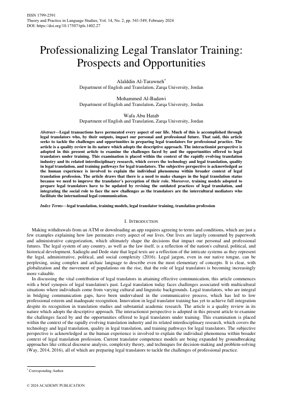
Legal transactions permeate modern life, from ATM withdrawals to app downloads governed by terms and conditions. This ubiquity underscores the critical role of legal translators, whose work directly impacts personal and professional futures. Legal systems reflect a nation's cultural, political, and historical fabric, making legal texts complex representations of administrative and social structures (Sadioglu & Dede, 2016). This article, a qualitative review adopting a descriptive and interactionist perspective, examines the challenges and opportunities in professionalizing legal translator training within the context of a rapidly evolving translation industry.
2. Legal Translation Explained
Legal translation involves transferring meaning between legal systems and languages, a task fraught with complexity due to system-bound terminology and cultural concepts.
2.1 Core Challenges
Challenges include dealing with archaic language, untranslatable concepts, and the precision required to avoid significant legal consequences. Multicultural situations further complicate the translator's role.
2.2 The Intercultural Mediator Role
The article argues for reconceptualizing legal translators as intercultural mediators who facilitate international legal communication, moving beyond mere linguistic transfer.
3. Current Training Models & Gaps
Despite academic recognition, innovation in legal translator training has not been fully integrated into professional practice.
3.1 Outdated Practices
Many training programs rely on traditional, text-centric methods that fail to address the dynamic, decision-heavy nature of professional legal translation work.
3.2 Competence Model Expansion
Groundbreaking approaches are expanding competence models, including critical discourse analysis, complexity theory, and decision-making/problem-solving techniques (Way, 2014, 2016).
4. Technology & Legal Translation
The integration of technology—such as CAT tools, terminology databases, and machine translation post-editing—presents both an opportunity and a challenge. Training must equip translators to use these tools critically while understanding their limitations in handling nuanced legal language.
5. Quality in Legal Translation
Defining and assessing quality in legal translation is multifaceted. It extends beyond linguistic accuracy to include functional adequacy within the target legal system and fidelity to the communicative purpose of the source text.
6. Training Pathways & Innovation
The article calls for updated training models that integrate the social role of the translator, revise outdated practices, and prepare trainees for real-world challenges through simulated tasks, interdisciplinary collaboration, and continuous professional development.
7. Key Insights & Statistical Overview
Core Driver for Change
Need to improve translators' perception of their role from technicians to intercultural mediators.
Primary Training Gap
Disconnect between academic research on innovative models (e.g., critical discourse analysis) and their implementation in professional training curricula.
Industry Pressure
Rapid evolution of translation technology and rising demand for cross-border legal communication necessitate updated skillsets.
8. Conclusion & Recommendations
The article concludes that professionalizing legal translator training requires systemic changes: updating pedagogical models, integrating technology thoughtfully, emphasizing the translator's social and mediating role, and fostering stronger academia-industry collaboration to ensure training relevance.
9. Original Analysis: A Critical Industry Perspective
Core Insight: The paper correctly diagnoses a profound identity crisis at the heart of legal translation. Translators are trapped between being viewed as glorified clerks handling paperwork and the reality of their role as essential architects of cross-jurisdictional understanding. This undervaluation, as the authors note, directly fuels low professional esteem—a critical barrier to attracting top talent and commanding appropriate fees.
Logical Flow & Strengths: The argument follows a compelling logic: the pervasive nature of law creates massive demand → meeting this demand requires skilled mediators → current training fails to produce these mediators → therefore, training must be revolutionized. Its strength lies in framing the solution not just in pedagogical terms but in sociological ones, advocating for the "intercultural mediator" paradigm. This aligns with broader trends in translation studies, such as the sociological turn championed by scholars like Michaela Wolf, which examines translators as agents within social networks.
Flaws & Missed Opportunities: The analysis, while sound, is frustratingly light on concrete, actionable models. It mentions "critical discourse analysis" and "complexity theory" but provides no blueprint for their integration. How does a trainee apply CDA to a non-disclosure agreement? The paper would be strengthened by referencing established, transferable pedagogical frameworks. For instance, the PACTE Group's holistic translation competence model, with its sub-competences (bilingual, extra-linguistic, instrumental, etc.), offers a tested structure that could be specifically adapted for legal contexts. Furthermore, the discussion on technology is superficial. It doesn't grapple with the disruptive potential of Large Language Models (LLMs). Unlike the predictable impact of earlier CAT tools, LLMs like GPT-4 challenge the very notion of "translation" as a discrete task, suggesting future training may need to focus on hybrid human-AI workflow design, prompt engineering for legal precision, and advanced post-editing strategies.
Actionable Insights: For training institutions, the imperative is to build curricula around decision-making under constraint—the core of professional legal work. This means moving from "find the equivalent" exercises to scenario-based learning: "Here is a source contract clause with a culturally specific concept. You have three client briefs with different risk tolerances. Draft three target versions and justify your choices." For the profession, bodies like the International Federation of Translators (FIT) must champion standardized certification that validates this higher-order mediation skill, not just linguistic knowledge, borrowing rigor from the legal field itself. The future legal translator isn't just a bilingual lawyer; they are a specialist in legal-linguistic risk management, a professional whose training is as rigorous and continuous as that of the attorneys they work alongside.
10. Technical Framework & Analytical Models
Analytical Framework Example (Non-Code): A proposed training module could be structured around a "Legal Translation Decision Matrix." Trainees analyze a source text (e.g., a "Force Majeure" clause) and must evaluate translation options against weighted criteria:
- Jurisdictional Fidelity (Weight: 0.4): Does the term exist/function similarly in the target legal system? (Scale: 1-5)
- Functional Equivalence (Weight: 0.3): Does the translation achieve the same legal effect? (Scale: 1-5)
- Linguistic Register (Weight: 0.2): Is the style appropriate (e.g., formal, archaic) for the target legal culture? (Scale: 1-5)
- Client Directive (Weight: 0.1): Does it align with the client's brief (e.g., "foreignizing" vs. "domesticating")? (Scale: 1-5)
The final score for an option is calculated as: $S = \sum_{i=1}^{4} (w_i \cdot r_i)$, where $w_i$ is the weight and $r_i$ is the rating for criterion $i$. This quantifies the often-intuitive decision process, fostering metacognitive skills.
Technical Detail & Formula: The complexity of legal translation can be partially modeled by measuring conceptual distance between legal systems. If a source concept $C_s$ has a set of features $F_s = \{f_1, f_2, ..., f_n\}$ and a target concept $C_t$ has features $F_t = \{f_1, f_2, ..., f_m\}$, the distance $D$ can be approximated using a modified Jaccard index: $D(C_s, C_t) = 1 - \frac{|F_s \cap F_t|}{|F_s \cup F_t|}$. A high $D$ indicates a "untranslatable" concept requiring compensatory strategies like paraphrasing or explanatory notes, a key skill for trainees.
11. Future Applications & Research Directions
- AI-Augmented Training Simulators: Development of immersive platforms using NLP to generate endless variations of legal translation scenarios with dynamic client feedback and simulated consequences of errors.
- Blockchain for Credentialing & Portfolio Verification: Creating immutable, shared ledgers for translator qualifications, specialization badges, and work portfolios, enhancing trust and mobility in the global market.
- Interdisciplinary "Legal Language Engineering" Programs: Joint degrees combining translation studies, computational linguistics, and comparative law to produce specialists who can design the next generation of legal translation technology.
- Empirical Research on Decision-Making: Eye-tracking and keystroke logging studies to map the cognitive processes of expert vs. novice legal translators, informing more effective pedagogical interventions.
- Standardized Global Competence Framework: Collaborative international effort to define and assess the core competencies of a professional legal translator, similar to the ISO 17100 standard but with legal-specific dimensions.
12. References
- Al-Tarawneh, A., Al-Badawi, M., & Abu Hatab, W. (2024). Professionalizing Legal Translator Training: Prospects and Opportunities. Theory and Practice in Language Studies, 14(2), 541-549.
- PACTE Group. (2003). Building a Translation Competence Model. In F. Alves (Ed.), Triangulating Translation: Perspectives in Process Oriented Research (pp. 43-66). John Benjamins.
- Way, C. (2014). Structuring a Legal Translation Course: A Framework for Decision-Making in Legal Translator Training. International Journal of Communication and Linguistic Studies, 12(1), 1-13.
- Way, C. (2016). The Challenges and Opportunities of Legal Translation and Translator Training in the 21st Century. International Journal of Legal Discourse, 1(1), 137-158.
- Wolf, M. (2007). The Location of the "Translation Field": Negotiating Borderlines between Pierre Bourdieu and Homi Bhabha. In M. Wolf & A. Fukari (Eds.), Constructing a Sociology of Translation (pp. 109-120). John Benjamins.
- Sadioglu, M., & Dede, S. (2016). The Role of Legal Translators in the Globalization Era. Journal of Law and Society, 7(2), 45-60.
- ISO 17100:2015. Translation services — Requirements for translation services. International Organization for Standardization.