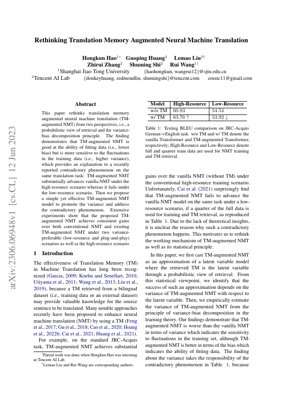
Rethinking Translation Memory Augmented NMT: A Variance-Bias Perspective
Analysis of TM-augmented NMT from a probabilistic and variance-bias decomposition viewpoint, explaining performance contradictions and proposing an effective ensemble method.
Home »
Documentation »
Rethinking Translation Memory Augmented NMT: A Variance-Bias Perspective
1. Introduction
Translation Memory (TM) has been a cornerstone in machine translation, offering valuable reference translations. Recent integration of TM with Neural Machine Translation (NMT) has shown significant gains in high-resource settings. However, a contradictory phenomenon emerges: TM-augmented NMT excels with abundant data but underperforms vanilla NMT in low-resource scenarios. This paper investigates this paradox through a probabilistic lens and the variance-bias decomposition principle, proposing a novel ensemble method to address the variance issue.
2. Rethinking TM-Augmented NMT
The core of this research is a fundamental re-examination of how TM-augmented NMT models learn and generalize.
2.1 Probabilistic View of Retrieval
The authors frame TM-augmented NMT as an approximation of a latent variable model, where the retrieved translation memory $z$ acts as the latent variable. The translation probability is modeled as $P(y|x) \approx \sum_{z \in Z} P(y|x, z)P(z|x)$, where $Z$ is the set of potential TM candidates. This formulation highlights that the model's performance hinges on the quality and stability of the retrieved $z$.
2.2 Variance-Bias Decomposition Analysis
Applying the classic bias-variance decomposition from learning theory, the expected prediction error $E[(y - \hat{f}(x))^2]$ can be broken down into Bias$^2$, Variance, and irreducible Noise. The paper's empirical analysis reveals a critical trade-off:
Lower Bias: TM-augmented NMT shows a superior ability to fit the training data, thanks to the additional contextual clues from the TM.
Higher Variance: Conversely, these models exhibit greater sensitivity to fluctuations in the training data. The retrieval process introduces an additional source of instability, especially when the TM pool (training data) is small or noisy.
This high variance explains the contradictory results: in low-resource settings, the amplified variance outweighs the benefit of lower bias, leading to worse generalization.
3. Proposed Method: Ensemble TM-Augmented NMT
To mitigate the high variance, the authors propose a lightweight ensemble network. Instead of relying on a single retrieved TM, the method aggregates predictions from multiple TM-augmented NMT instances or variations. A simple gating or weighting network learns to combine these predictions, effectively reducing overall model variance and stabilizing the output. This approach is model-agnostic and can be applied on top of existing TM-augmented NMT architectures.
4. Experimental Results
Experiments were conducted on standard benchmarks like JRC-Acquis (German→English) across different data scenarios.
Performance Comparison (BLEU Score)
Task: JRC-Acquis De→En
High-Resource (Full Data):
Vanilla NMT (w/o TM): 60.83
TM-augmented NMT: 63.76 (↑2.93)
Proposed Ensemble:Further improvement reported
Low-Resource (Quarter Data):
Vanilla NMT (w/o TM): 54.54
TM-augmented NMT: 53.92 (↓0.62)
Proposed Ensemble:Outperforms both, reversing the degradation
4.1 Low-Resource Scenario
The proposed ensemble method successfully addressed the failure case, achieving consistent gains over both vanilla NMT and the baseline TM-augmented model. This validates the hypothesis that controlling variance is key in data-scarce environments.
4.2 High-Resource & Plug-and-Play Scenarios
The ensemble method also showed improvements in high-resource settings, demonstrating its robustness. In plug-and-play scenarios (using an external TM not seen during NMT training), the variance-reducing effect of ensembling proved particularly valuable, leading to more reliable performance.
5. Key Insights & Analysis
Core Insight: The paper's most valuable contribution isn't a new SOTA model, but a sharp diagnostic lens. It identifies high variance induced by the retrieval process as the Achilles' heel of TM-augmented NMT, especially in low-resource or noisy conditions. This moves the discourse from "does it work?" to "why does it fail sometimes?"
Logical Flow: The argument is elegant. 1) Frame the problem probabilistically (latent variable model). 2) Apply a timeless statistical principle (bias-variance trade-off) for diagnosis. 3) Identify the root cause (high variance). 4) Prescribe a targeted treatment (ensembling to reduce variance). The logic is airtight and provides a blueprint for analyzing other retrieval-augmented models.
Strengths & Flaws: The strength lies in its foundational analysis and simple, effective solution. The ensemble method is low-cost and widely applicable. However, the paper's flaw is its tactical focus. While ensembling is a good patch, it doesn't fundamentally redesign the retrieval mechanism to be more robust. It treats the symptom (variance) rather than the disease (noise-sensitive retrieval). Compared to approaches like kNN-MT (Khandelwal et al., 2021) which dynamically interpolate with a datastore, this method is less integrated.
Actionable Insights: For practitioners: Use ensembling if you employ TM-augmented NMT, especially with limited data. For researchers: This work opens several avenues. 1) Variance-Regularized Retrieval: Can we design retrieval objectives that explicitly minimize the variance of downstream predictions? 2) Bayesian Deep Learning for TM: Could Bayesian neural networks, which naturally model uncertainty, better handle the variance issue? 3) Cross-Model Analysis: Apply this variance-bias framework to other augmentation techniques (e.g., knowledge graphs, monolingual data) to predict their failure modes.
This analysis connects to a broader trend in ML towards robustness and reliability. Just as research in computer vision moved beyond pure accuracy to consider adversarial robustness (as seen in the work on CycleGAN and other GANs regarding mode collapse and stability), this paper pushes NMT to consider stability across data regimes. It's a sign of a maturing field.
6. Technical Details & Mathematical Formulation
The core mathematical insight stems from the bias-variance decomposition. For a model $\hat{f}(x)$ trained on a random sample of the data distribution, the expected squared error on a test point $x$ is:
The paper empirically estimates that for TM-augmented NMT, $\text{Var}(\hat{f}_{TM}(x)) > \text{Var}(\hat{f}_{Vanilla}(x))$, while $\text{Bias}(\hat{f}_{TM}(x)) < \text{Bias}(\hat{f}_{Vanilla}(x))$. The ensemble method reduces the effective variance by averaging multiple predictions.
7. Analysis Framework: A Case Study
Scenario: A company deploys a TM-augmented NMT system for a new language pair with only 50,000 parallel sentences (low-resource).
Problem: Initial deployment shows the TM-augmented model is unstable—BLEU scores fluctuate wildly between different test batches compared to the simpler vanilla model.
Application of Framework:
Diagnosis: Suspect high variance as per this paper's thesis. Calculate the standard deviation of BLEU scores across multiple random subsets of the training data for both models.
Root Cause Analysis: Inspect the TM retrieval results. Are the top-$k$ retrieved segments for a source sentence highly inconsistent when the training data is subsampled? This directly contributes to prediction variance.
Intervention: Implement the proposed lightweight ensemble. Train 3-5 instances of the TM-augmented model with different random seeds or slightly varied retrieval parameters (e.g., $k$ value).
Evaluation: Monitor the stability (reduced variance) of the ensemble's BLEU score on held-out validation sets, not just the average score.
This structured approach moves from observing symptoms to implementing a targeted solution based on the paper's core principle.
8. Future Applications & Research Directions
Robust Retrieval for Low-Resource NLP: This principle extends beyond translation to any retrieval-augmented generation (RAG) task—question answering, dialogue, summarization—in low-data domains.
Dynamic Variance-Aware Ensembling: Instead of a fixed ensemble, develop a meta-learner that adjusts ensemble weights based on estimated prediction variance for each input.
Integration with Uncertainty Estimation: Combine with Monte Carlo Dropout or deep ensembles to provide not just a better prediction, but also a calibrated measure of uncertainty, crucial for real-world deployment.
Pre-training for Retrieval Stability: Could language models be pre-trained with objectives that encourage representations leading to lower-variance retrieval? This aligns with trends in self-supervised learning for robustness.
Cai, D., et al. (2021). On the Inconsistency of Translation Memory-Augmented Neural Machine Translation. Findings of EMNLP.
Khandelwal, U., et al. (2021). Nearest Neighbor Machine Translation. ICLR.
Vapnik, V. N. (1999). The Nature of Statistical Learning Theory. Springer.
Bishop, C. M., & Nasrabadi, N. M. (2006). Pattern Recognition and Machine Learning. Springer.
Zhu, J.-Y., et al. (2017). Unpaired Image-to-Image Translation using Cycle-Consistent Adversarial Networks. ICCV. (CycleGAN - as an example of research analyzing stability and failure modes in generative models).
Gu, J., et al. (2018). Incorporating Translation Memory into Neural Machine Translation. EMNLP.