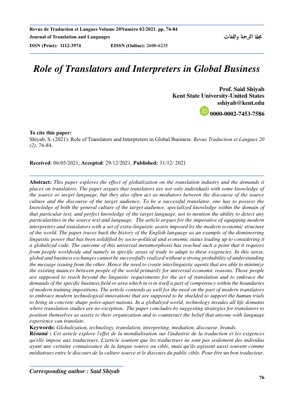
The Evolving Role of Translators and Interpreters in a Globalized Business Landscape
Analysis of how globalization and technology redefine translation demands, positioning translators as cultural mediators and strategic business assets.
Home »
Documentation »
The Evolving Role of Translators and Interpreters in a Globalized Business Landscape
1. Introduction & Overview
This paper critically examines the transformative impact of globalization on the translation and interpreting profession. It moves beyond the traditional view of translators as mere linguistic conduits, arguing for their reconceptualization as essential cultural and discursive mediators in international business. The central thesis posits that success in this new paradigm requires a fusion of deep linguistic expertise, specialized domain knowledge, cultural intelligence, and technological proficiency.
Core Publication Data
Journal: Revue de Traduction et Langues / Journal of Translation and Languages
Volume/Issue: 20, Numéro 02/2021
Pages: 76-84
Author: Prof. Said Shiyab, Kent State University
DOI/ISSN: EISSN: 2600-6235
2. Core Analysis
The paper deconstructs the modern translator's role through three interconnected lenses.
2.1 The Mediator Paradigm
Translators are positioned not as passive code-switchers but as active agents who mediate between the discourse of the source culture and the target audience. This requires:
Perfect Target Language Mastery: Beyond fluency to include stylistic and register appropriateness.
General Cultural Knowledge: Understanding the broader societal context of the target audience.
Specialized Domain Expertise: In-depth knowledge of the specific business field (e.g., legal, financial, technical).
Source Text Analysis: The ability to detect nuances, subtleties, and cultural particularities in the original material.
This framework directly challenges the pervasive misconception that "anyone with language experience can translate."
2.2 The English Hegemony & Economic Drivers
The paper uses the historical ascent of English as a globalized code to illustrate how socio-political and economic power solidifies linguistic dominance. This globalization creates an imperative for "interlinguistic agents" whose primary function is to minimize communicative nuances for universal economic reasons. The demand is thus economically generated, moving translation from a cultural service to a core business enabler.
2.3 Technological Imperative
The author contends that modern translators must embrace technological innovations. Technology is framed not as a threat but as a necessary tool "shielded to support human trials" in bridging disparate nations. In a globalized world, technology permeates all domains, including translation studies, necessitating that professionals integrate CAT tools, MT post-editing, and terminology management systems into their workflow.
3. Key Insights & Strategic Positioning
The conclusion offers strategic advice for translators to position themselves as valuable assets:
Articulate and demonstrate the value of mediation beyond literal translation.
Develop and market specialized domain expertise.
Integrate and master relevant translation technologies.
Proactively counteract the commoditization of translation by highlighting the risk and cost of low-quality, non-mediated work.
4. Original Analyst's Perspective
Core Insight: Shiyab's paper is a timely, defensive maneuver for the translation profession. It correctly identifies that the field's existential threat isn't just AI, but the pervasive undervaluation of its core competency: cultural-discursive mediation. The paper's real argument is that translators must rebrand from "language workers" to "risk mitigation specialists" in global communication.
Logical Flow & Strengths: The logic is compelling. It traces a clear causal chain: Globalization → English hegemony → complex business communication needs → demand for mediators (not just translators). Its strength lies in synthesizing sociolinguistics (the power of English) with practical translation theory. The call for domain specialization echoes findings from the EU's European Master's in Translation framework, which emphasizes the necessity of thematic competence alongside linguistic skills.
Flaws & Omissions: The paper's critical flaw is its surprisingly shallow treatment of technology. Mentioning it as an "imperative" is insufficient in 2021. It fails to engage with the disruptive, dual-edged nature of Neural Machine Translation (NMT). Unlike the transformative impact of models like CycleGAN in image-to-image translation, which introduced a novel unsupervised framework ($G: X \rightarrow Y$, $F: Y \rightarrow X$ with cycle-consistency loss $\mathcal{L}_{cyc}$), the discussion here lacks technical depth. It doesn't address how MT is reshaping the translator's workflow into post-editing or the ethical implications of AI-generated content. Furthermore, while it cites economic drivers, it provides no empirical data on market size, growth, or the ROI of professional translation vs. ad-hoc solutions—a missed opportunity to strengthen its business case.
Actionable Insights: For the industry, this paper is a blueprint for professional advocacy. Translation bodies should use its mediation framework to develop certification metrics that are harder to automate. For individual practitioners, the mandate is clear: specialize vertically (e.g., medical devices, fintech) and horizontally (technology adoption). The future isn't for generalist translators but for subject-matter expert mediators who can curate and correct the output of systems like GPT-4, ensuring brand safety and cultural appropriateness in a way pure technology cannot. The next evolution, which Shiyab hints at but doesn't explore, is the translator as a "localization strategist," integrated into product development cycles from the outset, a trend evident in companies like Netflix and Airbnb.
5. Technical Framework & Analysis
5.1 Competency Model & Mathematical Representation
The translator's competency ($C_t$) can be modeled as a multiplicative function of its core components, where a deficiency in one drastically reduces overall effectiveness:
$L_s, L_t$: Proficiency in Source and Target Language (0-1 scale).
$K_c$: Cultural Knowledge of target audience.
$K_d$: Specialized Domain Knowledge.
$M_t$: Mastery of Translation Technology.
This model illustrates why a bilingual individual ($L_s$ and $L_t$ high) with no domain knowledge ($K_d \approx 0$) fails: $C_t \rightarrow 0$.
Hypothetical Competency Score Visualization
Imagine a radar chart comparing two profiles:
Profile A (The "Bilingual"): Spikes in $L_s$ and $L_t$, but near-zero in $K_d$ and $M_t$. The chart area is small.
Profile B (The Professional Mediator): Balanced, high scores across all five axes. The chart area is significantly larger, representing greater overall competency and value.
This visual would starkly demonstrate the qualitative gap the paper describes.
5.2 Analytical Framework: The Business Translation Mediation Matrix
This framework helps categorize translation needs and required mediator expertise.
Text Type / Business Goal
Low Cultural Mediation Need (e.g., Technical Specs)
High Cultural Mediation Need (e.g., Marketing, Branding)
High Domain Complexity (e.g., Legal Contract, Pharma Patent)
Case Example (No Code): A company launches a fitness app in Japan. Translating the UI (low cultural mediation, medium domain complexity) requires a specialist familiar with tech and wellness terms. However, translating the marketing slogan "No Pain, No Gain" requires a creative mediator. A direct translation fails culturally, as it may convey unnecessary suffering. A mediator might transcreate it to align with Japanese values of perseverance and mastery, perhaps evoking the concept of "Kokoro" (heart/spirit) in training.
6. Future Applications & Directions
The trajectory outlined by Shiyab points to several key future developments:
AI-Human Symbiosis: The role will evolve towards "Translation Curator" or "MT Output Strategist," focusing on training AI models with domain-specific data, setting quality parameters, and handling high-stakes mediation that AI cannot.
Predictive Localization: Using data analytics to predict cultural reception and adapt content pre-emptively, moving from reactive translation to proactive global content strategy.
Ethical & Bias Auditing: A growing application will be auditing AI-generated translations for cultural bias, misinformation, and ethical misalignment, ensuring responsible global communication.
Integration in CX/UX Design: Translators/mediators will be embedded in product design teams from day one, ensuring products are built for global scalability (Internationalization/I18n).
Specialization in Crisis Communication: Managing multilingual communication during global crises (pandemics, supply chain issues) where precise, culturally-aware messaging is critical for brand reputation and public safety.
7. References
Shiyab, S. (2021). Role of Translators and Interpreters in Global Business. Revue Traduction et Langues, 20(2), 76-84.
Zhu, J., Park, T., Isola, P., & Efros, A. A. (2017). Unpaired Image-to-Image Translation using Cycle-Consistent Adversarial Networks. Proceedings of the IEEE International Conference on Computer Vision (ICCV). (Cited for comparative analysis of transformation frameworks).
European Commission. (2022). European Master's in Translation (EMT) Competence Framework. Directorate-General for Translation. (Provides authoritative backing for the multi-competence model).
Pym, A. (2020). Translation and Globalization: Key Concepts in the Digital Age. Routledge. (Contextualizes the economic and technological drivers).
TAUS. (2023). The State of the Translation Industry Report. (For empirical market data and trends on technology adoption).