1. Introduction
Language is dynamic, with new terms emerging and existing ones evolving or becoming obsolete daily. This constant flux presents a significant challenge for institutions that rely on accurate, up-to-date terminology, such as translators, content creators, and developers of Artificial Intelligence (AI) applications. Individual organizations often struggle to maintain their term collections due to a lack of proper management systems and standardized practices.
This paper addresses these challenges by presenting the EuroTermBank Toolkit (ETBT), an open terminology management solution designed to facilitate the sharing and management of terminology resources across a federated network of databases. The toolkit enables organizations to manage their terms, create collections, and share them both internally and externally, with curated data automatically contributing to EuroTermBank, Europe's largest multilingual terminology resource.
2. The EuroTermBank Toolkit (ETBT)
The ETBT is a standards-based software solution that allows organizations to establish their own terminology management nodes. These nodes can operate independently but are designed to connect and share data with the broader EuroTermBank Federated Network.
2.1 Core Functionality
- Term Management: Create, edit, search, and organize terminology entries.
- Collection Curation: Build and manage specific term collections for projects or domains.
- Standards Compliance: Supports ISO TC37 standards for terminology data (e.g., TermBase eXchange - TBX).
- Federated Sharing: Enables controlled sharing of terminology within and outside the organization via the federated network.
2.2 System Architecture
The architecture follows a client-server model where individual institutional nodes (federated databases) maintain local control over their data. A central harmonization layer, likely involving APIs and data exchange protocols adhering to standards like TBX, facilitates the aggregation of data into the central EuroTermBank repository. This design balances local autonomy with global resource consolidation.
3. Applications in Natural Language Processing
High-quality terminology is a critical resource for various NLP tasks, particularly those involving multilingualism.
3.1 Machine Translation Enhancement
Terminology integration is proven to significantly boost the quality of both statistical and neural machine translation (MT) systems. By ensuring domain-specific terms are translated consistently and correctly, tools like ETBT provide the structured data needed for constrained decoding or source-term tagging techniques in modern Neural MT (NMT) models.
3.2 Integration with AI Systems
Beyond translation, reliable terminology feeds into speech recognition, information extraction, and other AI-driven language understanding tools, improving their accuracy in specialized domains like law, medicine, or engineering.
4. Federated Network & Data Sharing
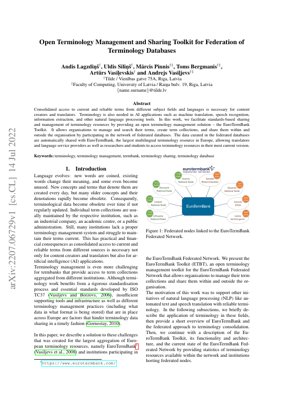
The federated approach is the cornerstone of the ETBT's strategy. Instead of a single, centralized database, it creates a network of interconnected nodes (see conceptual Figure 2 in the PDF). Institutions host their own terminology databases (federated nodes) and choose what to share with the network. Shared data is aggregated into the central EuroTermBank, creating a vast, always-current resource. This model incentivizes participation by allowing data owners to retain control while contributing to a communal asset.
Network Impact
The federated network model allows EuroTermBank to aggregate terminology from numerous independent sources, creating a resource that is more comprehensive, dynamic, and resilient than any single institution could maintain alone.
5. Key Insights & Analysis
6. Technical Details & Mathematical Framework
While the PDF does not delve into deep mathematical formalism, the underlying principle for terminology integration in systems like NMT can be framed as an optimization problem. A common approach is to bias the model's output distribution towards target-language terms that are known equivalents of source terms present in the input.
For instance, during the decoding step of an NMT model, a terminology constraint can be applied. If the source sentence contains a term $s_t$ which has a known translation $t_t$ in the terminology database, the model's probability distribution $P(y_i | y_{ $\log P'(y_i | ...) = \log P(y_i | ...) + \lambda \cdot \mathbb{1}(y_i = t_t)$ where $\mathbb{1}$ is the indicator function and $\lambda$ is a tunable hyperparameter controlling the strength of the constraint. More sophisticated methods involve constrained beam search or specialized tagging of source terms (Dinu et al., 2019; Bergmanis & Pinnis, 2021b). The structured data from ETBT provides the reliable $(s_t, t_t)$ pairs necessary for these techniques.
7. Experimental Results & Chart Description
The PDF references prior work demonstrating the efficacy of terminology integration but does not present new experimental results for ETBT itself. It cites studies showing terminology boosting MT quality (Pinnis, 2015) and more recent work on integrating terminology into neural systems (Bergmanis and Pinnis, 2021b).
Chart Description (Based on PDF Figure 1 & 2):
Figure 1 (Federated nodes linked to the EuroTermBank Federated Network): This likely depicts a hub-and-spoke diagram. The central hub is labeled "EuroTermBank." Radiating out from it are multiple nodes, each representing a different institution (e.g., "University A," "Company B," "Government Agency C"). Lines connect each institutional node to the central hub, visually representing the federated network where individual databases feed into the aggregate resource.
Figure 2 (A conceptual depiction of EuroTermBank Federated Network): This is described as a conceptual figure, probably illustrating the data flow and architecture. It likely shows the local terminology management happening within each institutional "node" using the ETBT software. Arrows would indicate the flow of curated terminology data from these local nodes to the central EuroTermBank repository, and potentially bidirectional arrows showing how users or applications can query both local and central resources.
8. Analysis Framework: Example Case
Scenario: The European Medicines Agency (EMA) needs to ensure consistent translation of new pharmaceutical substance names (INNs) across all EU languages in its regulatory documents.
ETBT Framework Application:
- Node Setup: EMA deploys the ETBT to create its own terminology node.
- Term Curation: EMA terminologists input new INN terms with definitions, contexts, and approved translations in 24 EU languages.
- Collection Management: They create a "Pharmaceutical INNs" collection within their node.
- Federated Sharing: EMA configures this collection to be shared with the EuroTermBank Federated Network.
- Downstream Impact:
- Internal: EMA translators and document writers use the local node via API/interface for consistent terminology.
- External: The terms are aggregated into EuroTermBank. A translation company in Poland can now access the official Polish translation of a new drug name via EuroTermBank's public portal.
- AI Integration: An NMT system used for translating medical documents can be configured to use the EuroTermBank API, applying constraints to ensure "Sacubitril" is always translated correctly, not transliterated or mistranslated.
9. Future Applications & Development Directions
- Real-time Terminology Propagation: Developing mechanisms for near-instantaneous updates from federated nodes to consuming applications (e.g., MT systems, CAT tools), moving from batch updates to a streaming model.
- AI-Powered Terminology Extraction & Curation: Integrating LLMs and unsupervised term extraction tools into the ETBT workflow to assist human terminologists in identifying and defining new terms from corpora, reducing manual effort.
- Blockchain for Provenance & Trust: Exploring decentralized ledger technology to immutably track the origin, edits, and approval status of each term entry, addressing the quality and governance gap. This could create a verifiable "trust score" for terminology data.
- Cross-modal Terminology: Extending the model beyond text to manage standardized terminology for speech recognition (acoustic models) and even image/video labeling (connecting terms to visual concepts), supporting multimodal AI.
- Deep Integration with LLMs: Using the federated terminology network as a reliable knowledge base to ground Large Language Models, preventing hallucination of technical terms and improving their performance in specialized domains—a concept aligned with research on retrieval-augmented generation (RAG).
10. References
- Arcan, M., et al. (2014). Leveraging Terminology Resources for Statistical Machine Translation in the CAT Domain. Proceedings of LREC.
- Arcan, M., et al. (2017). Statistical Machine Translation for Patent Documents with Terminology Handling. Proceedings of the 14th Conference of the European Association for Machine Translation (EAMT).
- Bergmanis, T., & Pinnis, M. (2021b). Dynamic Terminology Integration for Adaptive Neural Machine Translation. Findings of the Association for Computational Linguistics: EMNLP 2021.
- de Gspert, A., et al. (2018). The Tilde MT Platform for Professional Translators. Proceedings of the 15th Conference of the European Association for Machine Translation (EAMT).
- Dinu, G., et al. (2019). Training Neural Machine Translation to Apply Terminology Constraints. Proceedings of the 57th Annual Meeting of the Association for Computational Linguistics.
- Exel, M., et al. (2020). Terminology-Aware Sentence Mining for NMT Domain Adaptation. Proceedings of the 22nd Annual Conference of the European Association for Machine Translation (EAMT).
- Gornostay, T. (2010). Terminology Management in the European Union. Proceedings of the 14th EURALEX International Congress.
- Jon, R., et al. (2021). TermEval 2021: Shared Task on Automatic Term Extraction Using the Annotated Corpora for Term Extraction Research (ACTER) Dataset. Proceedings of the 8th Workshop on Natural Language Processing for Computer Assisted Translation (NLP4CAT).
- Pinnis, M. (2015). Domain Adaptation for Statistical Machine Translation with Terminology Mining and Term Translation. PhD Thesis, University of Latvia.
- Vasiljevs, A., & Borzovs, J. (2006). Towards Open and Dynamic Lexical and Terminological Resources. Proceedings of the 5th International Conference on Language Resources and Evaluation (LREC).
- Vasiljevs, A., et al. (2008). EuroTermBank: Towards Greater Interoperability of Distributed Terminology Resources. Proceedings of the 6th International Conference on Language Resources and Evaluation (LREC).
- Verplaetse, H., & Lambrechts, J. (2019). Terminology Management in a Modern Translation Workflow. The Journal of Specialised Translation, 31.
- Zhu, J., et al. (2017). Unpaired Image-to-Image Translation using Cycle-Consistent Adversarial Networks. Proceedings of the IEEE International Conference on Computer Vision (ICCV). [External reference on federated/cyclic learning structures]
- Wikimedia Foundation. (2023). Wikidata: Making a free, collaborative, multilingual database of the world's knowledge. https://www.wikidata.org. [External reference on collaborative data governance]
Core Insight
The ETBT isn't just another database tool; it's a strategic play to solve the "data silo" problem plaguing terminology management. Its real innovation is the federated network economic model, which uses a shared resource (EuroTermBank) as a carrot to incentivize decentralized data contribution, turning passive term collections into active, interconnected assets. This addresses the fundamental adoption hurdle noted in prior research (Gornostay, 2010).
Logical Flow
The paper's logic is sound: Identify the pain point (obsolete, fragmented terminology) → Propose a structural solution (federated nodes + shared toolkit) → Demonstrate value (applications in MT/NLP). The link between providing a free, easy-to-use management tool (ETBT) and growing the federated network is clear and compelling from a business development perspective.
Strengths & Flaws
Strengths: The focus on open standards (ISO TC37) is crucial for longevity and interoperability, a lesson learned from failed proprietary systems in other fields. The direct connection to real-world NLP applications (citing works like Bergmanis and Pinnis, 2021b) grounds the research in practical utility.
Flaws: The paper is conspicuously light on the governance and quality control mechanisms for the federated network. How are conflicting term definitions from different nodes resolved? What prevents garbage-in-garbage-out at the central repository? These are non-trivial challenges, as seen in other collaborative data projects like Wikidata, and their absence is a notable gap in the proposed architecture.
Actionable Insights
For institutions: Implementing ETBT is a low-risk way to modernize terminology work with a clear path to external collaboration. For researchers: The federated dataset created by this network is a goldmine for training and evaluating domain-adaptive NLP models. The community should pressure the ETBT team to publish detailed protocols for data conflict resolution and quality assurance to ensure the network's long-term health and scientific credibility.